Alphabet

Phonics

Literacy

Math

Centers

Fine Motor
and Crafts

Teacher
Tips

Author name: sabrini025

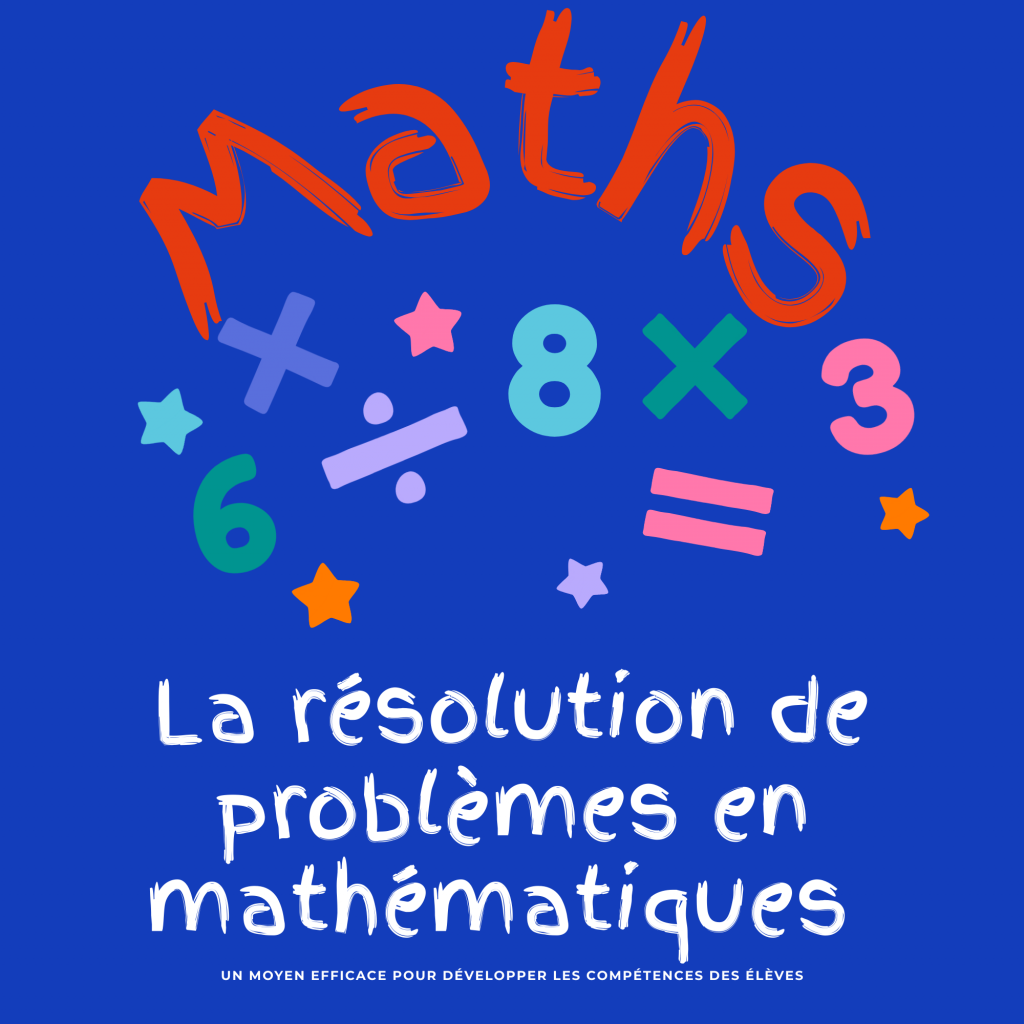
La résolution de problèmes en mathématiques : un moyen efficace pour développer les compétences des élèves

La résolution de problèmes est au cœur de l’apprentissage des mathématiques. Elle ne se limite pas à trouver la bonne réponse : elle engage les élèves dans un processus de réflexion, d’analyse et de raisonnement logique. Pour les enseignants, intégrer la résolution de problèmes dans les pratiques pédagogiques est une stratégie efficace pour développer la pensée critique et la confiance des élèves dans leurs capacités mathématiques. Pourquoi la résolution de problèmes est-elle essentielle ? Développement des compétences cognitivesEn travaillant sur des problèmes mathématiques, les élèves apprennent à identifier les informations pertinentes, à organiser leurs idées et à appliquer des stratégies variées pour trouver des solutions. Ces compétences vont bien au-delà des mathématiques : elles renforcent la capacité à réfléchir de manière structurée face à toute situation complexe. Renforcement de la compréhension conceptuelleLes élèves qui se contentent de mémoriser des formules ont souvent du mal à appliquer leurs connaissances dans des contextes nouveaux. La résolution de problèmes encourage une compréhension profonde : ils doivent comprendre pourquoi et comment une méthode fonctionne, ce qui favorise une maîtrise durable des concepts. Encouragement de l’autonomie et de la persévéranceLes problèmes mathématiques stimulent la créativité et la persévérance. Les élèves apprennent que l’erreur fait partie du processus d’apprentissage et qu’il existe souvent plusieurs façons d’aborder une question. Cette expérience favorise la confiance en soi et l’autonomie. Comment intégrer la résolution de problèmes en classe ? Proposer des problèmes progressifsCommencez par des problèmes simples pour renforcer la confiance des élèves, puis introduisez progressivement des défis plus complexes qui sollicitent plusieurs compétences simultanément. Encourager la discussion et le partage de stratégiesPermettre aux élèves de discuter de leurs méthodes de résolution favorise l’apprentissage collaboratif et expose chacun à différentes manières de penser. Relier les problèmes à la vie quotidienneLes problèmes inspirés de situations réelles motivent les élèves et montrent la pertinence des mathématiques dans le monde qui les entoure. Utiliser la réflexion post-solutionUne fois le problème résolu, encouragez les élèves à expliquer leur démarche, à identifier les difficultés rencontrées et à réfléchir sur des stratégies alternatives. Cela consolide leur apprentissage. L’utilité pour les enseignants Pour les enseignants, la résolution de problèmes est un outil précieux : elle permet d’évaluer non seulement la capacité des élèves à trouver la bonne réponse, mais aussi leur compréhension des concepts et leur capacité à raisonner de manière autonome. Elle aide également à identifier les difficultés spécifiques de chaque élève et à adapter l’enseignement en conséquence. ConclusionLa résolution de problèmes en mathématiques n’est pas seulement une compétence académique : c’est une compétence de vie. En intégrant cette approche dans la classe, les enseignants permettent aux élèves de développer leur esprit critique, leur créativité et leur confiance en eux. Plus que des calculs, la résolution de problèmes forme des penseurs capables de relever les défis avec logique et persévérance.

La résolution de problèmes en mathématiques : un moyen efficace pour développer les compétences des élèves Read More »

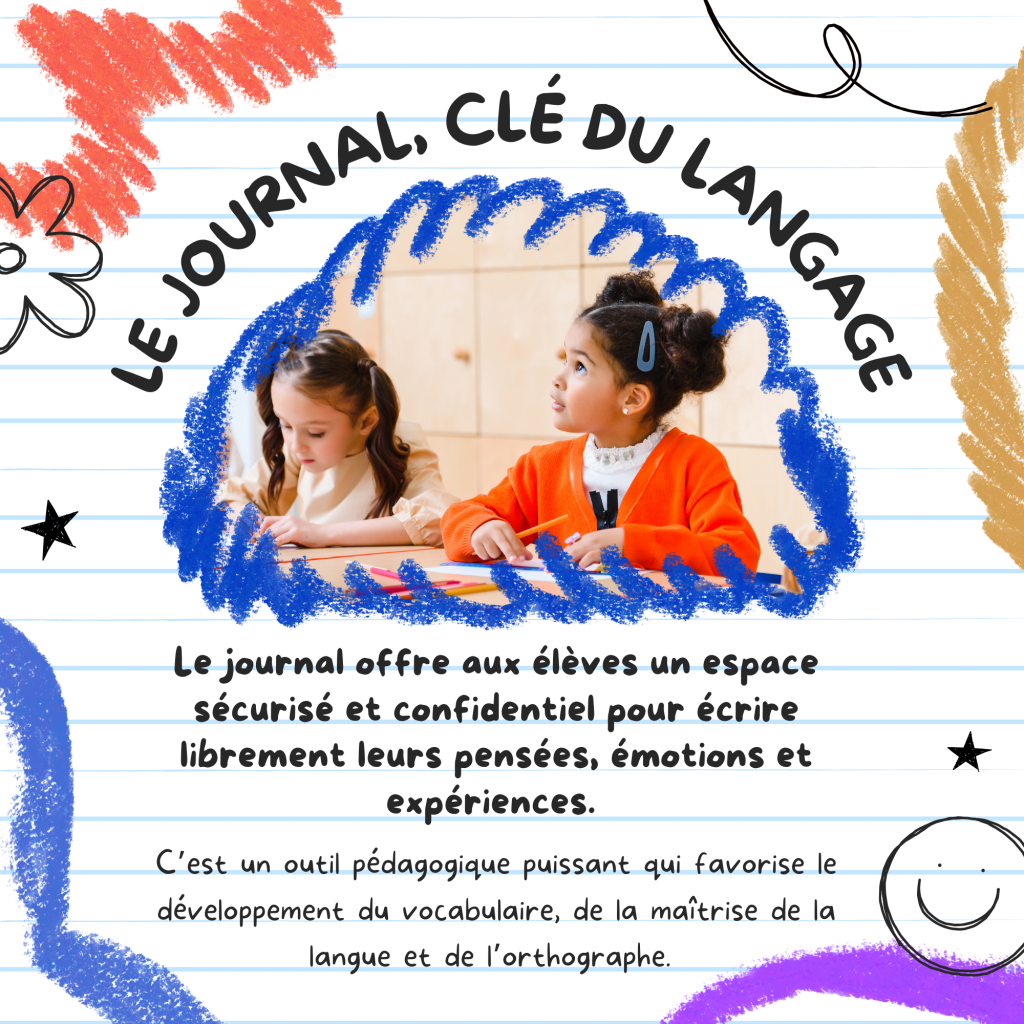
Le journal personnel : un outil efficace pour le développement du langage et de l’apprentissage

Le journal personnel : un outil efficace pour le développement du langage et de l’apprentissage Le journal personnel est bien plus qu’un simple carnet où l’élève raconte sa journée. C’est un outil pédagogique puissant qui favorise le développement du vocabulaire, de la maîtrise de la langue et de l’orthographe. Enseignants et parents peuvent tirer de grands bénéfices de sa pratique régulière, tant sur le plan scolaire que sur le plan personnel. 1. Le journal personnel, un espace pour s’exprimer librement Le journal offre aux élèves un espace sécurisé et confidentiel pour écrire librement leurs pensées, émotions et expériences. Cette liberté d’expression les incite à réfléchir et à formuler leurs idées avec leurs propres mots. Contrairement aux exercices scolaires classiques, le journal n’est pas évalué sur le “bon” ou “mauvais” résultat, ce qui réduit la pression et encourage l’expérimentation linguistique. Pour les enseignants, cela représente une opportunité unique d’observer le développement du langage chez chaque élève, de comprendre ses préoccupations et ses centres d’intérêt, et de détecter d’éventuelles difficultés en lecture, en orthographe ou en expression écrite. 2. Développement du vocabulaire et de la maîtrise de la langue Écrire régulièrement dans un journal permet aux élèves d’enrichir leur vocabulaire. Chaque nouvelle idée ou expérience nécessite de trouver le mot juste, ce qui stimule la curiosité lexicale et l’apprentissage des synonymes. De plus, la pratique régulière de la rédaction améliore la structuration des phrases et la cohérence des textes. Les élèves apprennent progressivement à organiser leurs idées, à varier leurs formulations et à maîtriser les subtilités de la langue française. Les enseignants peuvent encourager cet apprentissage en proposant, de temps à autre, de nouveaux mots ou expressions à utiliser dans le journal. 3. Amélioration de l’orthographe et de la grammaire Le journal personnel est également un excellent outil pour renforcer l’orthographe et la grammaire. En relisant leurs textes, les élèves identifient eux-mêmes leurs erreurs et développent une conscience de la langue. Cette pratique régulière, combinée à un retour constructif de l’enseignant ou du parent, permet de corriger progressivement les fautes tout en renforçant l’autonomie. Les parents peuvent participer en lisant occasionnellement le journal et en proposant des corrections douces ou des suggestions, transformant l’écriture en un moment d’apprentissage agréable et positif. 4. Développer la créativité et l’esprit critique Au-delà de la langue, le journal stimule la créativité et l’esprit critique. Les élèves peuvent écrire des histoires, des poèmes ou des réflexions sur des événements vécus. Cette pratique développe leur capacité à analyser, interpréter et relier différentes idées, compétences essentielles dans tous les domaines scolaires. 5. Conseils pratiques pour enseignants et parents Régularité : Encouragez l’élève à écrire tous les jours ou plusieurs fois par semaine, même quelques lignes suffisent. Liberté : Laissez l’élève choisir le sujet pour favoriser l’engagement. Encouragement : Valorisez l’effort plutôt que la perfection. Les commentaires positifs stimulent la motivation. Partage sélectif : Offrez la possibilité de partager certains écrits en classe ou à la maison pour renforcer la confiance en soi. Accompagnement : Proposez des défis linguistiques, comme l’utilisation d’un nouveau mot chaque semaine ou la rédaction d’une petite histoire avec un début et une fin. Conclusion Le journal personnel est un outil simple mais puissant pour favoriser l’apprentissage chez les élèves. Il permet de développer le vocabulaire, la maîtrise de la langue, l’orthographe, la créativité et l’esprit critique. Pour les enseignants comme pour les parents, c’est un moyen concret d’accompagner l’enfant dans sa progression tout en cultivant le plaisir d’écrire. Introduire le journal personnel dans la routine scolaire ou familiale, c’est offrir aux élèves un véritable levier pour leur réussite scolaire et leur épanouissement personnel.

Le journal personnel : un outil efficace pour le développement du langage et de l’apprentissage Read More »

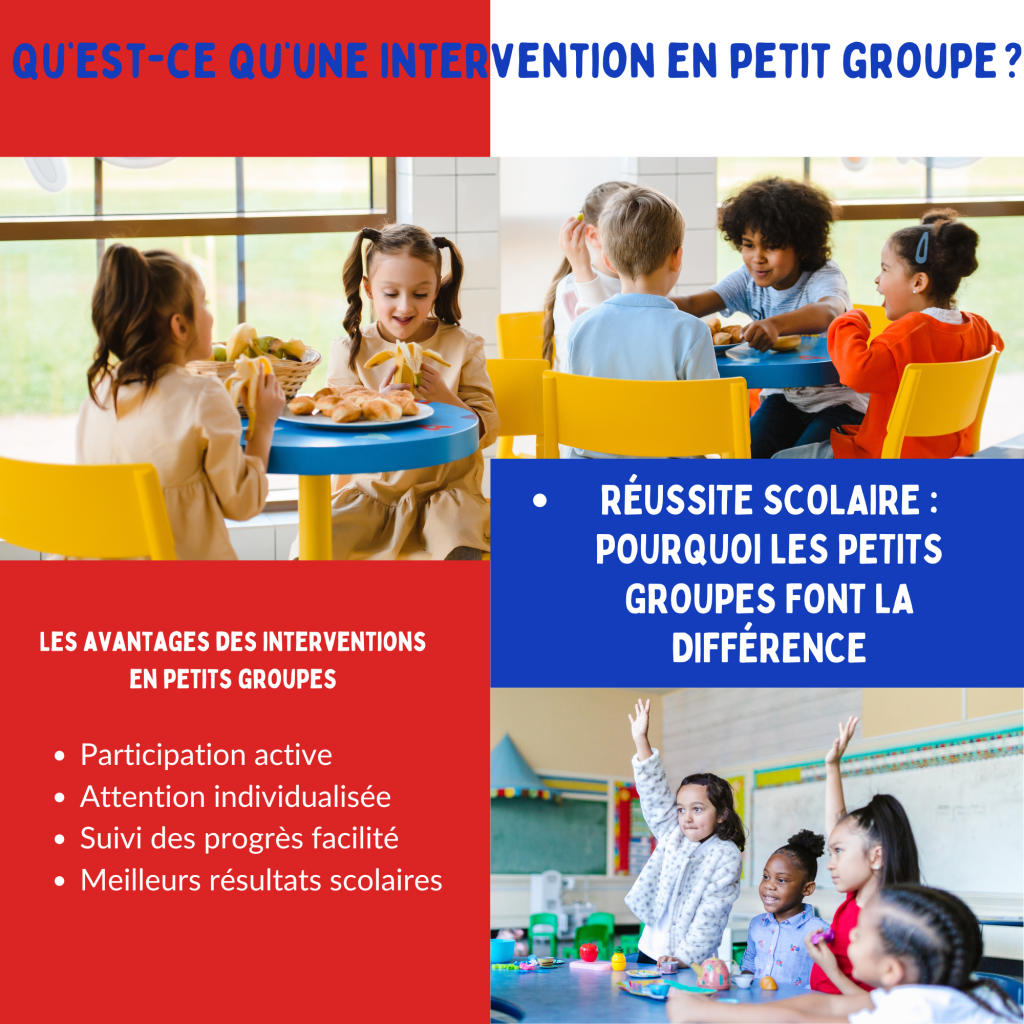
Réussite scolaire : pourquoi les petits groupes font la différence

Améliorer l’apprentissage grâce aux interventions en petits groupes L’apprentissage en milieu scolaire est un processus complexe qui varie énormément d’un élève à l’autre. Chaque enfant possède ses propres forces, faiblesses et rythmes d’apprentissage. Dans ce contexte, les interventions en petits groupes se révèlent être une stratégie particulièrement efficace pour soutenir les élèves et améliorer leurs performances scolaires. Mais qu’entend-on exactement par « interventions en petits groupes » et pourquoi sont-elles si bénéfiques ? Qu’est-ce qu’une intervention en petit groupe ? Une intervention en petit groupe consiste à regrouper un nombre restreint d’élèves, souvent entre 3 et 6, pour travailler sur des objectifs pédagogiques spécifiques. Contrairement à l’enseignement en classe entière, cette approche permet à l’enseignant de cibler des besoins précis, d’adapter le rythme de l’enseignement et de proposer des activités différenciées. Ces groupes peuvent être formés selon différents critères : Niveau de compétence : les élèves ayant des difficultés similaires peuvent travailler ensemble pour renforcer leurs compétences. Intérêts communs : regrouper des élèves autour d’un sujet qui les motive peut augmenter leur engagement. Style d’apprentissage : certains élèves apprennent mieux visuellement, d’autres par la manipulation ou la discussion. Les avantages des interventions en petits groupes 1. Une attention plus individualisée En travaillant avec un nombre réduit d’élèves, l’enseignant peut observer chaque élève de près, identifier rapidement ses difficultés et adapter son enseignement en conséquence. Cette attention individualisée favorise la confiance en soi et la motivation des élèves. 2. Renforcement de la participation active Dans un petit groupe, chaque élève a davantage d’occasions de s’exprimer, poser des questions et participer aux activités. Cela stimule la réflexion critique, la créativité et la collaboration entre pairs. 3. Possibilité de différenciation pédagogique Les petits groupes permettent de personnaliser les activités et les contenus selon le niveau de chaque élève. Par exemple, certains élèves peuvent bénéficier d’exercices de renforcement, tandis que d’autres explorent des tâches plus complexes, sans que l’ensemble de la classe soit freiné ou frustré. 4. Suivi plus efficace des progrès L’enseignant peut suivre de manière régulière les progrès de chaque élève, identifier les lacunes et ajuster ses interventions rapidement. Cela permet également d’instaurer un feedback immédiat, qui est crucial pour l’apprentissage. Comment organiser des interventions efficaces en petits groupes Pour que ces interventions soient réellement bénéfiques, plusieurs éléments doivent être pris en compte : Définir des objectifs clairsAvant chaque session, il est important de savoir exactement ce que les élèves doivent apprendre ou améliorer. Planifier des activités variéesAlterner entre discussions, exercices pratiques, jeux pédagogiques et manipulations concrètes permet de maintenir l’attention et de répondre aux différents styles d’apprentissage. Évaluer régulièrementUn suivi continu permet de mesurer l’efficacité des interventions et d’ajuster le contenu ou la taille des groupes si nécessaire. Favoriser l’interaction entre pairsMême si le groupe est petit, les élèves peuvent apprendre beaucoup les uns des autres. Les discussions guidées, le tutorat par les pairs ou les projets collaboratifs sont autant de moyens de renforcer l’apprentissage. Conclusion Les interventions en petits groupes représentent un outil puissant pour améliorer l’apprentissage des élèves, surtout dans un contexte où les besoins varient fortement d’un enfant à l’autre. Elles permettent de combiner attention individualisée, différenciation pédagogique et engagement actif. Pour les enseignants, il s’agit d’une approche stratégique qui, bien planifiée et régulièrement évaluée, peut transformer la dynamique de la classe et favoriser la réussite scolaire de tous les élèves.

Réussite scolaire : pourquoi les petits groupes font la différence Read More »

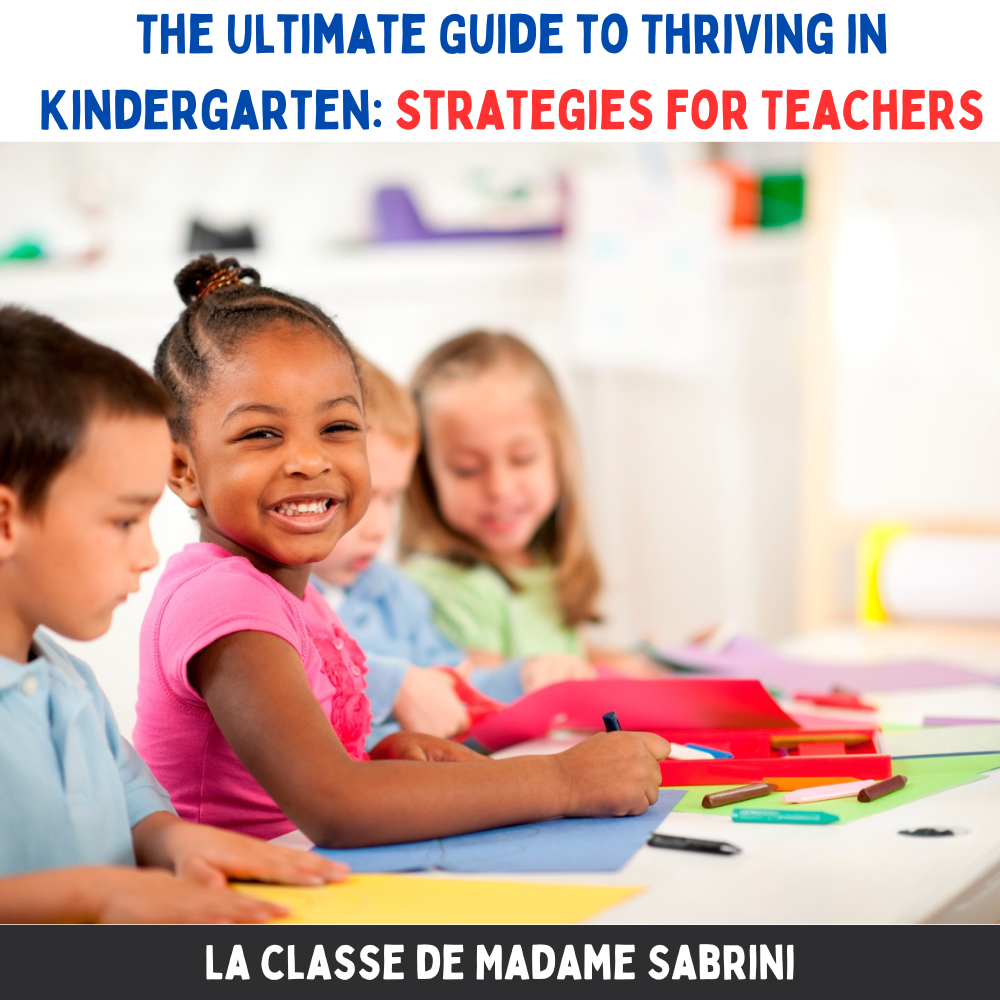
Strategies for Teachers

Welcome to your go-to resource for mastering the art and science of kindergarten! Teaching at this level is as much about education as it is about nurturing growth and development in our youngest learners. It’s a magical time of exploration and excitement, not just for the kids but also for you, the teacher. The secret sauce to a thriving kindergarten classroom? A balance between structured education and the unique developmental needs of children. Let’s dive into how you can create that perfect harmony, ensuring your classroom is a space where every child feels engaged, understood, and supported. 1. Building a Positive Classroom Environment 1.1 Classroom Management Tips Setting clear expectations: Begin by establishing what you expect from your students – not just in terms of behavior but also in their eagerness to learn and participate. Make these expectations clear from day one and revisit them often. The role of routines in maintaining order: Routines are the backbone of a well-managed classroom. They give children a sense of security and predictability, making it easier for them to understand what’s expected of them. Tips for creating a supportive classroom community: Encourage your students to see themselves as a part of a team. Activities that promote cooperation and empathy go a long way in building a sense of community. 1.2 Kindergarten Behavior Charts Introduction to behavior charts: Behavior charts can be a visual way for students to track their progress. It’s not about highlighting negatives but rather celebrating the positives and providing gentle corrections. How to implement behavior charts effectively: Make sure the criteria for success are achievable and understood by all. Regularly update and review the charts with your students to keep them engaged. Measuring success with behavior charts: Success isn’t just about a fully stickered chart; it’s seeing your students understand and correct their behavior, growing more respectful and responsible. 1.3 Positive Reinforcement Techniques Understanding positive reinforcement: This is all about acknowledging and rewarding desirable behaviors, which encourages students to repeat them. Examples of positive reinforcement in action: Whether it’s verbal praise, a sticker, or some extra playtime, find out what motivates your students individually and as a group. Monitoring and adjusting strategies for individual needs: Keep an eye on how effective your reinforcement strategies are and be ready to adapt them to meet the evolving needs of your class. 2. Designing Engaging and Educational Activities 2.1 Engaging Classroom Activities The importance of engagement in early education: Engagement is the gateway to learning. Activities need to grab attention and spark curiosity to be effective. Ideas for activities that capture attention and educate: Think outside the box with hands-on experiments, storytelling sessions, and art projects that tie back to your learning objectives. How to adapt activities for diverse learner needs: Every child learns differently. Be prepared to tweak your activities to ensure everyone can participate and learn in a way that suits them best. 2.2 Interactive Learning Games Benefits of learning through play: Play is a powerful tool in early childhood education. It not only teaches academic skills but also social ones, in a way that’s natural and enjoyable for kids. Suggestions for interactive games in various subjects: From math and science to literature and social studies, there’s a game for that. Use technology, board games, or simple group activities to bring lessons to life. Using technology to enhance learning experiences: Smartboards, tablets, and educational apps can make learning interactive and fun. Just be sure to balance screen time with plenty of hands-on activities. 2.3 Creative Circle Time Ideas Making the most of circle time: This is your chance to spark discussions, get to know your students, and allow them to share their thoughts and feelings. Activities and games for effective circle times: From reading a captivating story to playing a group game, circle time should be something everyone looks forward to. Strategies for involving every student: Encourage shy students by gently inviting them to participate and giving them praise when they do. Make circle time inclusive and engaging for all. 3. Effective Communication and Social Skills 3.1 Teaching Social Skills Essential social skills for kindergarten students: Sharing, listening, empathy, and patience are just the start. These skills are crucial for classroom harmony and outside social interactions. Activities to encourage social development: Group projects, role-playing exercises, and cooperative games can all foster social skills. Integrating social skills into daily routines: Make social skills practice a part of every day, from morning meetings to lunchtime behavior. 3.2 Conflict Resolution for Kids Identifying common conflicts among kindergarten students: Sharing, turn-taking, and personal space often lead to disputes at this age. Techniques for teaching kids to resolve conflicts: Teach them to use their words, recognize emotions, and find compromises. Model these behaviors yourself to provide clear examples. Role-play scenarios to practice conflict resolution: Real-life scenarios can prepare students to handle disputes calmly and respectfully. 3.3 Enhancing Parent-Teacher Communication The importance of parent-teacher partnership: A strong connection between home and school supports the child’s overall development and learning. Platforms and strategies for effective communication: Whether it’s through email, a class website, or face-to-face meetings, keep the lines of communication open. Handling difficult conversations with parents: Be honest, empathetic, and solution-focused. Remember, you’re on the same team. 4. Creating an Organized and Conducive Learning Space 4.1 Classroom Organization Ideas Organizing materials for easy access and efficiency: Keep your classroom tidy and your materials well-organized to save time and reduce stress. Creating zones within the classroom for various activities: Designate specific areas for reading, play, art, and study. This helps manage transitions and keeps the day flowing smoothly. Tips for maintaining an organized space throughout the year: Involve your students in the process. Assign classroom jobs and regularly declutter. 4.2 Kindergarten Classroom Setup Planning the layout for optimal learning and movement: Adequate space for activities and safe movement is key. Arrange your classroom to minimize chaos and maximize learning. Essential elements of a kindergarten classroom: Think about what you’ll need for your daily activities. A reading corner, an art station, and

Strategies for Teachers Read More »

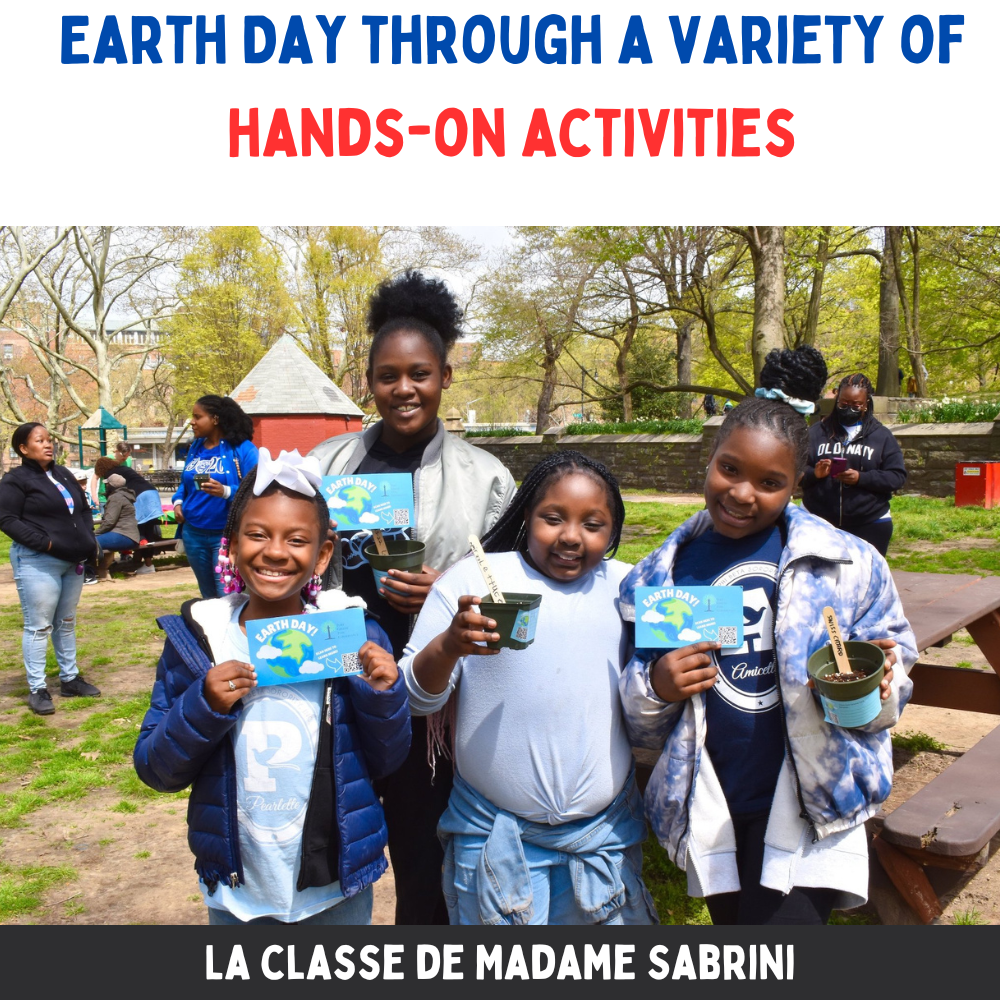
Teaching kindergarteners about Earth Day

Teaching kindergarteners about Earth Day through a variety of hands-on activities can be both fun and educational. Start by gathering the children together and introducing the concept of Earth Day in simple terms, explaining that it’s a special day when people all around the world celebrate our planet and learn how to take care of it.   For a craft activity, engage the children in creating recycled art. Provide a variety of recycled materials such as cardboard, paper rolls, bottle caps, and fabric scraps, along with glue, scissors, and markers. Encourage them to use their creativity to make artwork using these materials, reinforcing the idea that recycling is important for preserving our environment. Hand out coloring worksheets featuring a simple Earth outline and prompts such as “I promise to recycle” or “I promise to plant trees.” Let the children color the Earth and complete the sentences with their own promises to take care of the planet. This activity helps reinforce the concept of personal responsibility for the environment in a fun and interactive way.   Take the children outside for a nature scavenger hunt to explore their surroundings and discover the wonders of the natural world. Provide each child with a list of items to find, such as leaves, flowers, rocks, and insects. Encourage them to use their senses to observe and appreciate the beauty of nature while also reinforcing concepts such as biodiversity and ecosystem health. Gather the children for a storytime session featuring age-appropriate books about Earth Day and environmental conservation. Choose engaging picture books that convey important messages about topics like recycling, energy conservation, and protecting wildlife. After reading each book, facilitate a discussion to help the children understand the key concepts and how they can apply them in their own lives.   Set up a planting station where the children can learn about the importance of plants in our ecosystem. Provide small pots, soil, and seeds for easy-to-grow plants like sunflowers, beans, or herbs. Guide the children through the process of planting their seeds and explain how plants help clean the air, provide food, and create habitats for animals. Wrap up the day with a fun Earth Day song that reinforces the themes of environmental stewardship and appreciation for nature. Encourage the children to sing along and dance to the music, fostering a sense of joy and connection to the planet. Finally, gather the children for a brief reflection where they can share what they’ve learned and express their commitment to taking care of the Earth. By incorporating these activities, you can create a rich and memorable Earth Day experience for kindergarteners that not only teaches them important lessons about environmental conservation but also inspires them to become stewards of the planet for years to come.  

Teaching kindergarteners about Earth Day Read More »

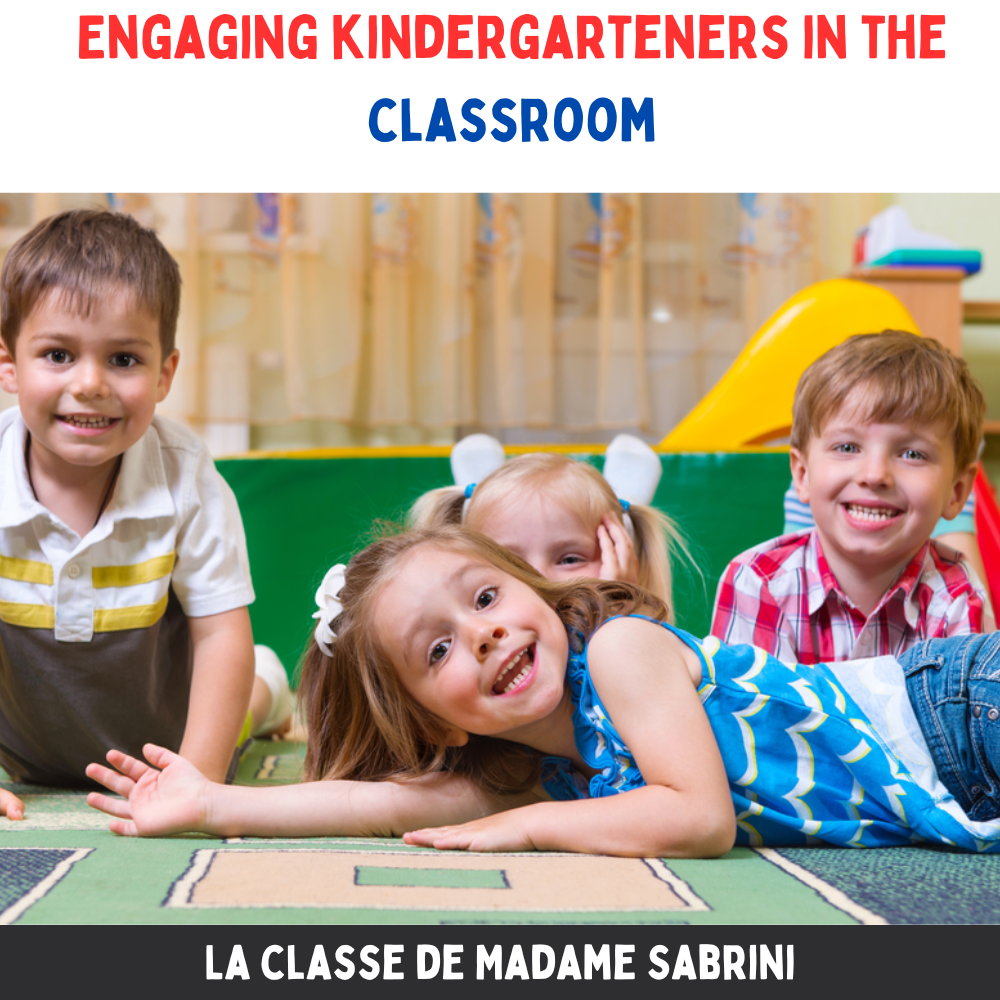
Creating an Engaging Kindergarten Classroom: A Guide for Teachers and Parents

  Engaging kindergarteners in the classroom is not only essential for their academic development but also for fostering a lifelong love of learning. As both teachers and parents, we play a crucial role in creating an environment that is stimulating, nurturing, and filled with opportunities for exploration and discovery. First and foremost, establishing a welcoming environment sets the tone for the entire learning experience. Greet each child with a smile and a warm welcome, making them feel valued and excited to be in the classroom. Providing cozy reading corners with soft cushions and a variety of age-appropriate books encourages children to explore the world of literature at their own pace. Assigning personalized spaces, such as cubbies or areas for their belongings, helps children feel a sense of ownership and belonging in the classroom. Incorporating hands-on activities is key to keeping kindergarteners engaged and excited about learning. Sensory play, such as finger painting, playdough sculpting, or exploring sensory bins filled with rice or beans, allows children to engage their senses and learn through tactile experiences. Learning centers, featuring areas like blocks, dramatic play, art stations, and science tables, offer children the opportunity to explore different interests and engage in independent or group activities. Visual aids and props are invaluable tools for enhancing learning and comprehension in young children. Utilizing a visual schedule with pictures helps children understand the daily routine and reduces anxiety about transitions. Props and manipulatives, such as counting bears for math activities or animal figurines for storytelling, make abstract concepts more tangible and engaging. Movement and music are powerful tools for capturing children’s attention and keeping them actively engaged in learning. Incorporating short movement breaks throughout the day allows children to release energy and refocus their attention. Singing songs, reciting rhymes, and incorporating music into lessons not only make learning fun but also support language development and memory retention. Fostering collaboration and social skills is essential for helping children develop strong interpersonal relationships and communication skills. Planning group activities that encourage teamwork and problem-solving, such as group art projects or cooperative games, teaches children the value of working together towards a common goal. Role-playing activities provide opportunities for children to practice social skills like sharing, taking turns, and conflict resolution in a safe and supportive environment. Encouraging curiosity and exploration is fundamental to fostering a love of learning in young children. Taking advantage of outdoor spaces for nature walks and exploration allows children to connect with the natural world and discover new wonders. Embracing inquiry-based learning by encouraging children to ask questions and explore topics that interest them promotes a sense of autonomy and curiosity. Communication with parents is essential for creating a strong home-school connection and supporting children’s learning and development. Maintaining open lines of communication through newsletters, emails, or parent-teacher conferences keeps parents informed about classroom activities, upcoming events, and their child’s progress. Providing parents with resources and ideas for extending learning at home, such as suggested books, educational apps, or simple activities, empowers them to support their child’s learning journey beyond the classroom. In conclusion, creating an engaging kindergarten classroom requires a collaborative effort between teachers and parents. By establishing a welcoming environment, incorporating hands-on activities, utilizing visual aids and props, integrating movement and music, fostering collaboration and social skills, encouraging curiosity and exploration, and maintaining open communication with parents, we can create a dynamic learning environment where every child feels valued, supported, and inspired to reach their full potential. Together, we can lay the foundation for a lifetime of learning and growth.

Creating an Engaging Kindergarten Classroom: A Guide for Teachers and Parents Read More »

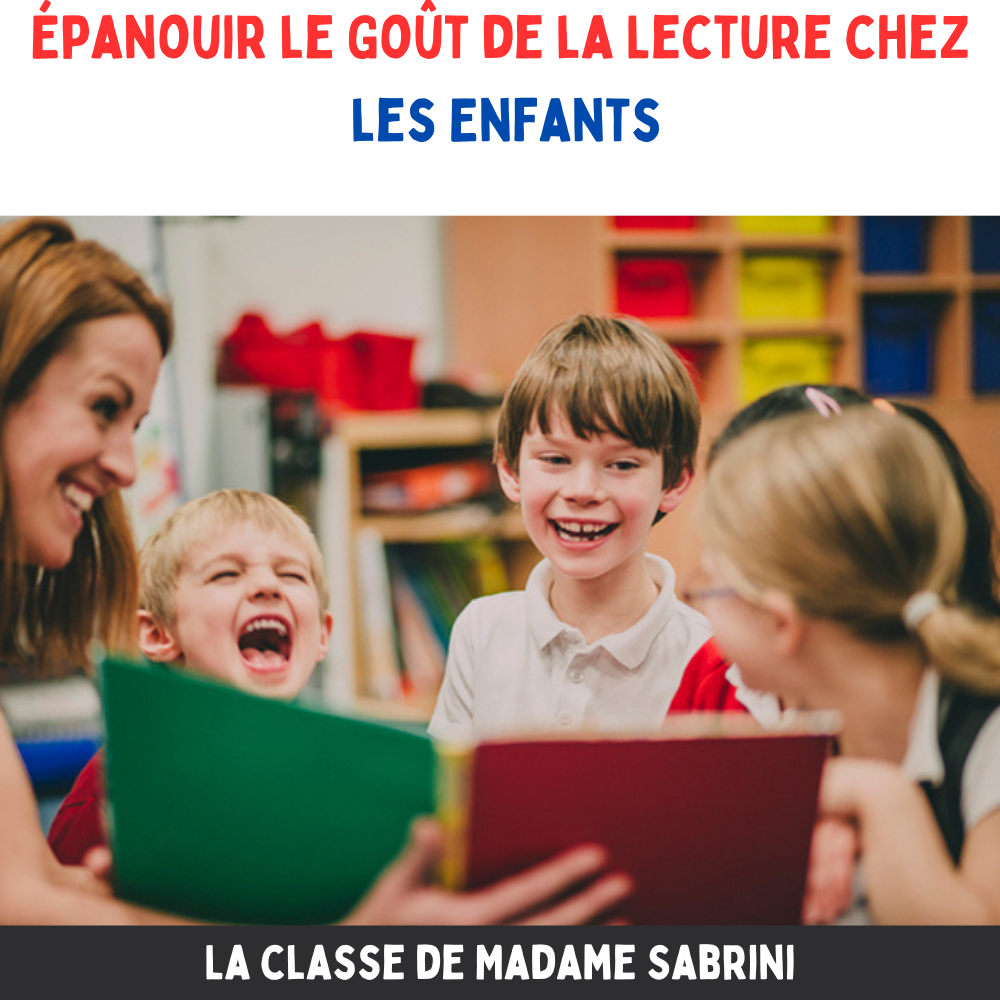
Cultiver le Plaisir de la Lecture chez les Enfants : Un Partenariat Entre Enseignants et Parents

  L’apprentissage de la lecture est une étape cruciale dans le développement des enfants. C’est une compétence fondamentale qui ouvre la porte à la découverte, à l’imagination et à la connaissance. Dans cet article, nous explorerons comment les enseignants et les parents peuvent collaborer pour aider leurs enfants à développer le plaisir de la lecture dès leur plus jeune âge. 1. Créer un Environnement Favorable à la Lecture Les parents et les enseignants ont un rôle essentiel dans la création d’un environnement propice à la lecture. À la maison, aménagez un coin lecture confortable avec une variété de livres adaptés à l’âge de l’enfant. En classe, assurez-vous que la bibliothèque est bien fournie et encouragez les élèves à emprunter des livres régulièrement.   2. Modéliser le Comportement de Lecteur Les enfants apprennent beaucoup en observant les adultes qui les entourent. Les enseignants et les parents peuvent donc jouer un rôle de modèle en démontrant régulièrement leur amour de la lecture. Montrez-leur que la lecture est une activité enrichissante et qu’elle fait partie intégrante de votre vie quotidienne.   3. Encourager la Lecture à Voix Haute La lecture à voix haute est un moyen puissant de stimuler l’amour de la lecture chez les enfants. Les enseignants peuvent intégrer cette pratique en classe, tandis que les parents peuvent la mettre en œuvre à la maison. Lors de ces sessions, discutez des histoires, posez des questions et encouragez les enfants à partager leurs propres réflexions.   4. Individualiser l’Apprentissage de la Lecture Chaque enfant est unique, avec son propre rythme et son style d’apprentissage. Les enseignants peuvent différencier leur enseignement en adaptant les activités de lecture aux besoins individuels des élèves. De même, les parents peuvent fournir un soutien personnalisé à la maison en choisissant des livres qui correspondent aux intérêts spécifiques de leur enfant.   5. Intégrer la Technologie de Manière Pertinente La technologie peut être un outil précieux pour stimuler l’intérêt des enfants pour la lecture. Les enseignants peuvent incorporer des applications éducatives interactives en classe, tandis que les parents peuvent superviser l’utilisation de tablettes et d’autres dispositifs à la maison. Il est cependant crucial de maintenir un équilibre et de garantir que la technologie complète plutôt qu’elle ne remplace l’expérience traditionnelle de la lecture. En collaborant étroitement, les enseignants et les parents peuvent créer un environnement d’apprentissage harmonieux qui encourage les enfants à développer une relation positive avec la lecture. En insufflant le plaisir de lire dès le plus jeune âge, nous contribuons à préparer nos enfants à un avenir où la connaissance et la compréhension sont des atouts inestimables.

Cultiver le Plaisir de la Lecture chez les Enfants : Un Partenariat Entre Enseignants et Parents Read More »

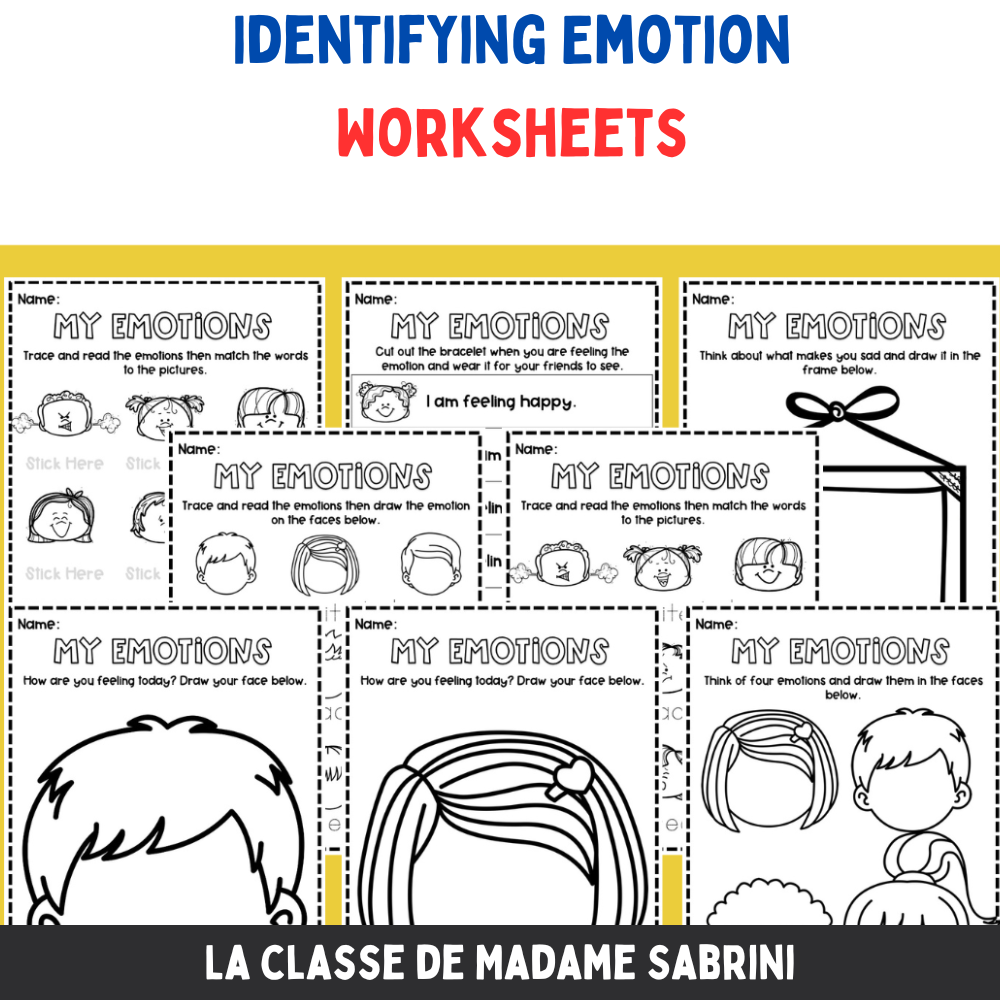
Recognizing Emotions Made Easy with Our Kindergarten Worksheets

Teaching children about emotions is an essential part of their social and emotional development. However, it can often be challenging to find the right resources and tools to effectively teach this concept to young learners. That’s why we have created our emotions worksheets for kindergarten students. These worksheets are designed to make learning about emotions easy, fun, and interactive. With a variety of activities and exercises, these worksheets will help children recognize and understand their own emotions as well as those of others. Let’s dive in and see how our emotions worksheets for kindergarten can help your child develop a better understanding of their feelings. Understanding the Importance of Emotion Recognition in Children Emotion recognition is a fundamental skill that plays a crucial role in a child’s overall development. It allows children to understand and navigate their own emotions, as well as interpret and respond to the emotions of others. By recognizing and acknowledging their emotions, children can better express themselves, establish meaningful relationships, and develop empathy and compassion. Emotion recognition in children is particularly significant because it sets the foundation for emotional intelligence. Research has shown that children who have a higher level of emotional intelligence are more likely to succeed academically, have healthier relationships, and exhibit better mental health. Moreover, emotion recognition helps children manage their emotions effectively. By identifying and labeling their feelings, children gain a sense of control over their emotional experiences, leading to increased self-regulation skills. They learn how to express their emotions appropriately, rather than resorting to tantrums or aggression. Additionally, emotion recognition is essential for social interactions. When children can recognize emotions in others, they are better equipped to understand and respond to the needs and feelings of those around them. This leads to stronger social connections, improved communication skills, and a greater sense of belonging. By emphasizing emotion recognition in children, we empower them to navigate the complexities of the social world with confidence and understanding. It is an invaluable skill that will benefit them throughout their lives. In the following sections, we will explore various tools and strategies to help children develop this vital skill, starting with our Emotions and Feelings flashcards. Exploring Our Emotions and Feelings Flashcards Our Emotions and Feelings flashcards are a fantastic resource for kindergarten students to explore and understand their emotions. These flashcards feature a range of colorful and engaging illustrations that depict various emotions, such as happiness, sadness, anger, and surprise. By using these flashcards, children can begin to identify and label different emotions, making the abstract concept of feelings more concrete and tangible. One activity you can do with the flashcards is to play a game of “Emotion Charades.” Have your child pick a card from the deck and act out the emotion without speaking. You can take turns guessing what emotion they are portraying. This game not only helps children recognize different emotions, but it also encourages them to express and communicate their feelings in a nonverbal way. Another activity is to have your child sort the flashcards into categories based on the intensity of the emotions depicted. For example, they can sort the cards into “mild,” “moderate,” and “intense” emotions. This activity promotes emotional awareness and helps children understand that emotions can vary in intensity. Additionally, you can use the flashcards to create storytelling prompts. Choose a card and ask your child to create a story that revolves around that particular emotion. This activity encourages imagination and empathy, as children have to put themselves in the shoes of someone experiencing that emotion. Overall, our Emotions and Feelings flashcards are a versatile and valuable tool for teaching children about emotions. Through engaging activities and discussions, children can develop a better understanding of their own feelings and those of others. Incorporating Kindergarten Worksheets in Emotional Learning In addition to our Emotions and Feelings flashcards, our emotions worksheets for kindergarten provide valuable tools to enhance emotional learning in young children. These worksheets are designed to be interactive and engaging, making it easy for children to grasp the concepts of emotions and their expressions. By incorporating these worksheets into their daily routine, parents and educators can create a supportive environment for emotional growth and development. The worksheets cover a range of topics, including identifying emotions, expressing feelings, and understanding the emotions of others. They feature a variety of activities such as coloring, matching, and drawing, allowing children to learn about emotions through hands-on experiences. By completing these activities, children can not only develop a better understanding of their own emotions but also practice empathy and compassion towards others. Incorporating these worksheets into emotional learning activities can be done in a variety of ways. They can be used as a standalone activity, or integrated into existing lesson plans. Parents and educators can also use them as conversation starters, discussing the different emotions depicted in the worksheets and encouraging children to share their own experiences. By incorporating our emotions worksheets into their emotional learning journey, parents and educators can provide children with the tools they need to develop a better understanding of their emotions. This will not only benefit their social and emotional development but also set them on a path towards greater emotional intelligence and well-being.   The Role of Open Conversation in Developing Emotional Intelligence Open conversation plays a crucial role in developing emotional intelligence in children. When children feel comfortable talking about their emotions, it fosters a deeper understanding of their feelings and encourages self-reflection. By engaging in conversations about emotions, children learn to identify and articulate their feelings, which leads to better emotional regulation and self-awareness. Through open conversation, children also learn to listen and empathize with others. When they share their emotions and experiences, it opens up opportunities for connection and understanding. They can learn from each other’s perspectives and gain insight into different ways of processing and expressing emotions. This helps children develop empathy and compassion, essential skills for building meaningful relationships. Parents and educators can create a supportive environment for

Recognizing Emotions Made Easy with Our Kindergarten Worksheets Read More »

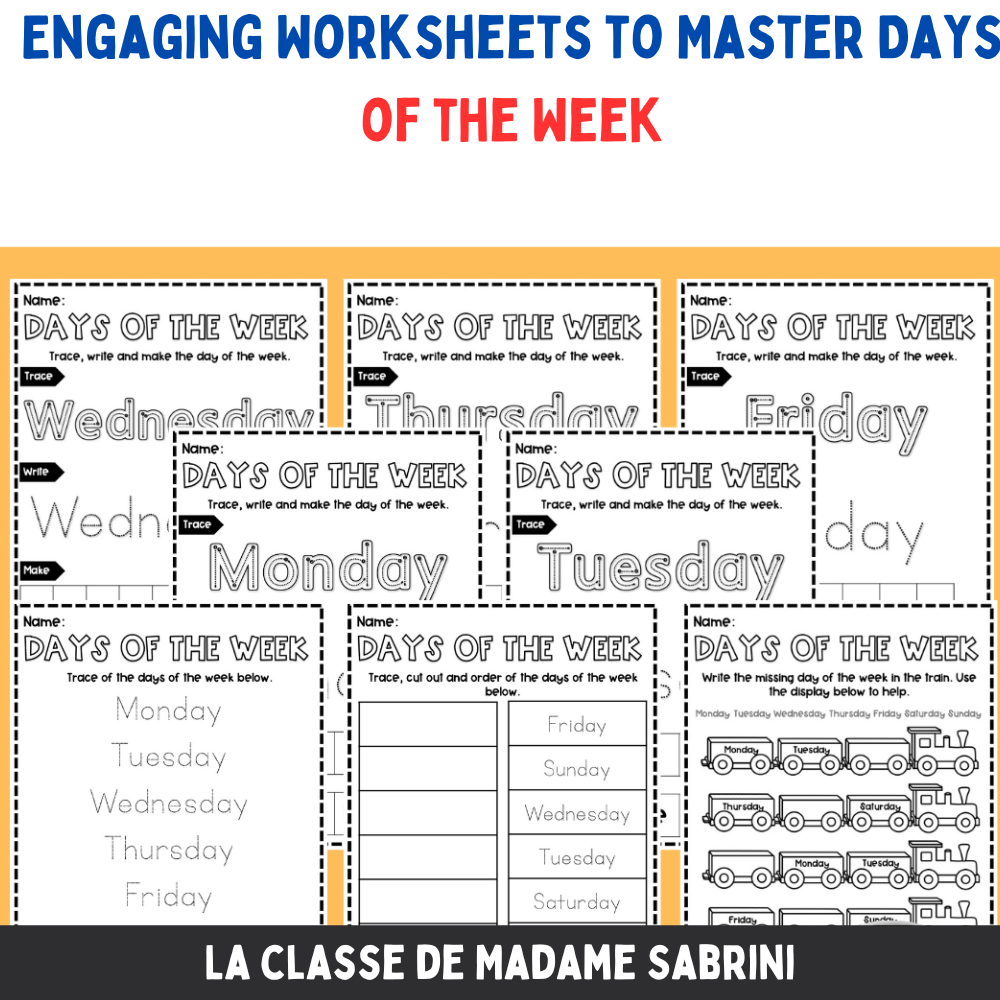
Fun-filled learning: Engage your little ones with Days of the Week Worksheets for Kindergarten

Welcome to the world of fun-filled learning for your little ones! As a parent or teacher, you know how important it is to engage children in interactive and educational activities. That’s why we are excited to introduce you to Days of the Week Worksheets for Kindergarten. These worksheets are a great way to help your child learn the days of the week while having fun at the same time. In this blog post, we will explore the many benefits of using these worksheets and how they can make learning a more enjoyable experience for your kindergarten students. What are Days of the Week Worksheets for Kindergarten? Days of the Week Worksheets for Kindergarten are a set of educational resources designed to help young children learn and practice the days of the week. These worksheets provide a fun and interactive way for children to engage with this important concept, allowing them to develop important cognitive skills while having a great time. Each worksheet is carefully designed to cater to the specific needs of kindergarten students. They feature colorful and engaging visuals, as well as activities and exercises that encourage active learning. Children will have the opportunity to trace and write the days of the week, complete puzzles and matching games, and even color in pictures related to each day. These hands-on activities help children become familiar with the order and spelling of the days, as well as develop essential skills such as sequencing and pattern recognition. Days of the Week Worksheets can be incorporated into your child’s daily routine easily. They can be used during circle time, as part of a morning routine, or even as a quiet time activity. This flexibility allows you to tailor the learning experience to your child’s preferences and needs. By using these worksheets consistently, your child will gain a solid understanding of the days of the week while enjoying the process of learning. Why are they beneficial for learning? Days of the Week Worksheets for Kindergarten offer a multitude of benefits for your child’s learning and development. These worksheets are not only a fun and engaging way to teach the days of the week, but they also provide numerous cognitive benefits. First and foremost, these worksheets help children with sequencing skills. Learning the order of the days of the week can be a challenging concept for young children, but by using these worksheets, they can practice arranging the days in the correct order. This enhances their ability to understand and remember sequential information, which is an essential skill for academic success. Furthermore, these worksheets promote pattern recognition. Each day of the week has its own unique spelling and visual representation. By consistently tracing, writing, and identifying the days, children develop a visual memory for these patterns. This strengthens their pattern recognition skills, which are important for math, reading, and problem-solving. Another benefit of these worksheets is their ability to enhance memory. Repetition is key when it comes to memory retention, and by consistently engaging with the days of the week through the various activities on the worksheets, children are more likely to remember them. This boosts their memory skills and lays a solid foundation for future learning. Additionally, the interactive nature of the worksheets keeps children actively involved in the learning process. The coloring, tracing, writing, and puzzle activities all contribute to a hands-on learning experience. This active engagement not only makes learning more enjoyable, but it also helps children retain information better. Tips for using Days of the Week Worksheets effectively Now that you have your Days of the Week Worksheets for Kindergarten, let’s talk about some tips for using them effectively to maximize your child’s learning experience. 1. Consistency is key: Make sure to incorporate the worksheets into your child’s daily routine. Whether it’s during circle time, morning activities, or quiet time, try to use the worksheets consistently to reinforce their understanding of the days of the week. Repetition is crucial for memory retention, so the more your child engages with the worksheets, the better they will remember the information. 2. Start with the basics: Begin by introducing the days of the week in order and gradually move on to more advanced activities. This progressive approach helps your child build a solid foundation and prevents them from feeling overwhelmed. Start with tracing and writing the days, and then move on to puzzles, matching games, and other interactive exercises. 3. Tailor the activities to your child’s interests: Make the learning experience more enjoyable by incorporating your child’s interests into the activities. For example, if your child loves animals, include pictures of different animals for each day of the week and have them match the animals to the correct day. This personalization keeps your child engaged and motivated to learn. 4. Celebrate progress: Recognize and celebrate your child’s achievements and progress. Encourage them to take pride in their learning and accomplishments. Display their completed worksheets on a wall or refrigerator, and praise their efforts. Positive reinforcement goes a long way in motivating children to continue learning and growing. 5. Use the worksheets as a starting point: The Days of the Week Worksheets are a fantastic resource, but they can also serve as a springboard for further learning. Once your child has mastered the days of the week, explore related concepts such as months, seasons, and holidays. This expands their knowledge and keeps their curiosity alive.  

Fun-filled learning: Engage your little ones with Days of the Week Worksheets for Kindergarten Read More »

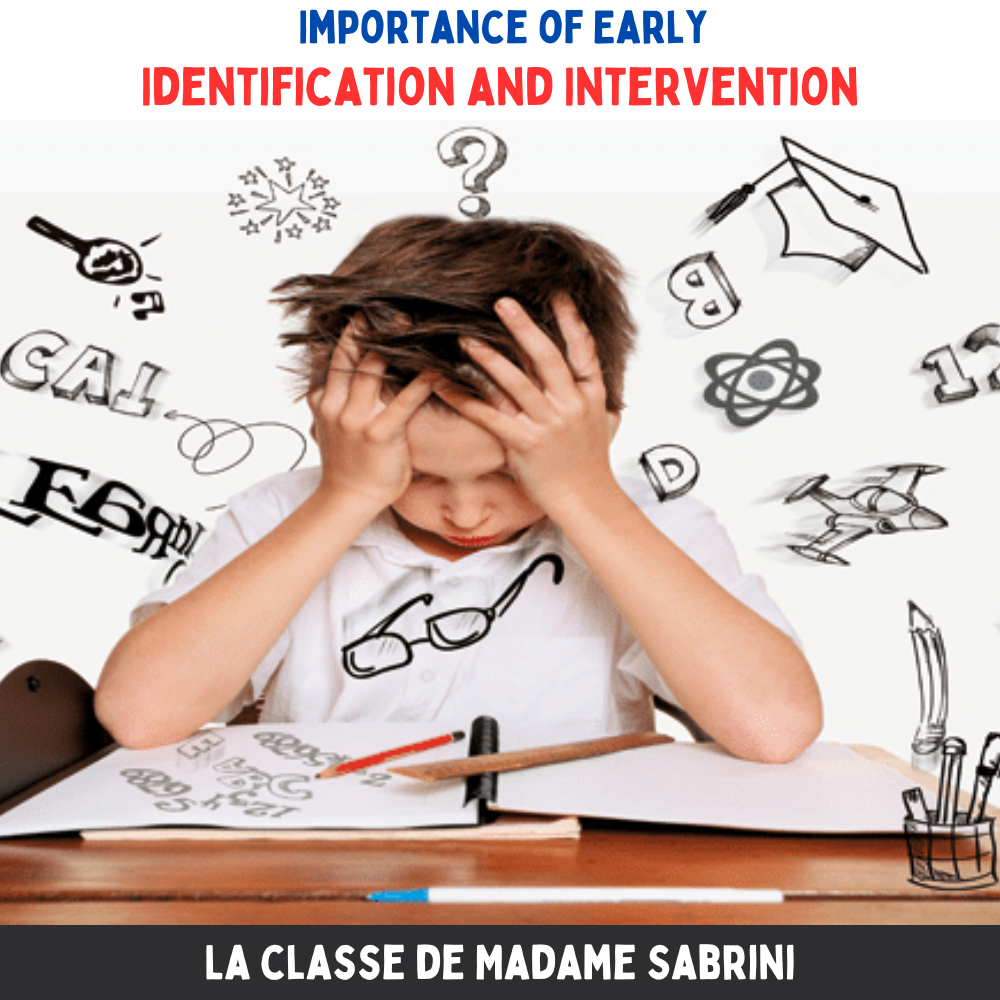
Unlocking Potential: Strategies for Supporting Students with Adjustment and Learning Difficulties

Students with adjustment and learning difficulties can face a range of challenges in the classroom. Despite this, these students often have great potential that can be unlocked with the right strategies. In this blog post, we’ll explore effective approaches for supporting and guiding these students, enabling them to reach their full potential. Read on to discover more about unlocking potential for students with adjustment and learning difficulties. Understanding Adjustment and Learning Difficulties Adjustment and learning difficulties can present significant challenges for students in the classroom. These difficulties can affect various aspects of a student’s academic performance, social interactions, and overall well-being. To effectively support and guide these students, it is crucial for teachers to have a deep understanding of their unique needs and the underlying causes of their difficulties. Students with adjustment and learning difficulties often struggle with processing information, organizing tasks, focusing, and retaining information. They may have difficulties with reading, writing, math, or even simple everyday tasks. These difficulties can be caused by various factors, including cognitive processing deficits, attention deficit disorders, language or sensory processing disorders, or even emotional and behavioral challenges. It is essential for teachers to be familiar with the specific learning difficulties their students may be facing. This knowledge allows them to tailor their teaching methods and strategies to meet the individual needs of each student. By understanding the underlying causes of these difficulties, teachers can provide targeted interventions and support to help students overcome their challenges and reach their full potential. Furthermore, understanding adjustment and learning difficulties helps teachers create a compassionate and inclusive classroom environment. It enables them to foster a culture of empathy, understanding, and acceptance among all students. By promoting a positive learning environment, teachers can encourage collaboration, respect, and support among students with and without difficulties.     Common Challenges Faced by Students with these Difficulties Students with adjustment and learning difficulties face a multitude of challenges in the classroom. These challenges can vary greatly depending on the specific difficulties that students are dealing with. Some common challenges faced by these students include difficulties with organization and time management, trouble focusing and sustaining attention, struggles with memory and retention, and difficulties with social interactions. Organization and time management can be particularly challenging for these students. They may have difficulty keeping track of assignments, remembering deadlines, and prioritizing tasks. This can lead to feelings of overwhelm and stress, as well as a lack of motivation and productivity. Trouble focusing and sustaining attention is another common challenge. Students with adjustment and learning difficulties may have a hard time staying engaged in classroom activities, maintaining concentration, and ignoring distractions. This can make it difficult for them to fully participate in lessons and grasp new concepts. Memory and retention issues can also pose challenges for these students. They may struggle to retain information presented in class, leading to difficulties with understanding and applying new knowledge. This can impact their overall academic performance and self-confidence. Additionally, social interactions can be a source of difficulty for students with adjustment and learning difficulties. They may have trouble forming and maintaining friendships, understanding social cues, and navigating social situations. This can lead to feelings of isolation and affect their overall well-being. It is important for teachers to be aware of these common challenges in order to provide the necessary support and accommodations. By addressing these challenges head-on and implementing strategies to overcome them, students with adjustment and learning difficulties can thrive in the classroom and reach their full potential.     Importance of Early Identification and Intervention Early identification and intervention play a crucial role in supporting students with adjustment and learning difficulties. By identifying these difficulties early on, teachers and other education professionals can provide targeted interventions and support to help students overcome their challenges and reach their full potential. Early identification allows teachers to understand and address the specific needs of students with adjustment and learning difficulties. It enables them to tailor their teaching methods and strategies to meet the individual needs of each student. By implementing appropriate interventions early, students can receive the necessary support and accommodations that will help them succeed in the classroom. Additionally, early intervention can prevent these difficulties from becoming more severe or affecting other aspects of a student’s life. By addressing challenges early, teachers can help students develop the necessary skills and strategies to overcome their difficulties, promoting long-term success and well-being. Early identification and intervention also play a crucial role in fostering a positive learning environment. By identifying students’ difficulties early, teachers can create a compassionate and inclusive classroom where all students feel valued and supported. This can promote a culture of empathy, understanding, and acceptance among all students. Moreover, early intervention can have a significant impact on students’ overall well-being. By addressing adjustment and learning difficulties early, teachers can help students build resilience, develop self-confidence, and improve their overall mental health. Early intervention is not just about academic success; it is about supporting the whole student. Creating a Supportive Learning Environment Creating a supportive learning environment is crucial for students with adjustment and learning difficulties. It is in this environment that they can thrive, feel valued, and reach their full potential. Teachers play a key role in establishing this environment by fostering a culture of empathy, understanding, and acceptance among all students. To create a supportive learning environment, teachers should prioritize open communication and create a safe space for students to express their needs and concerns. They can establish regular check-ins with students to understand their challenges and provide the necessary support. Additionally, teachers can encourage peer collaboration and support, allowing students to learn from and support one another. Teachers can also implement various strategies to accommodate different learning styles and needs. For example, providing visual aids, using hands-on activities, and incorporating technology can enhance engagement and understanding for students with adjustment and learning difficulties. Flexible seating arrangements and quiet areas can also help students focus and feel more comfortable in the classroom. Furthermore, promoting a

Unlocking Potential: Strategies for Supporting Students with Adjustment and Learning Difficulties Read More »

Scroll to Top